
Optimizing Your Content to Work with Schema

SUMMARY
Structured data helps you perform better for GEO - but it doesn’t mean starting from scratch. Schema.org provides a variety of pre-determined themes for you to sort your content into so that it can be better understood by LLMs.
Table of Contents
- Why Everyone is Talking About Schema
- Where to Start (and Busting Some Myths)
- What Comes Next - Implement and Iterate
AIO and GEO optimization is the name of the game these days, and site owners understand that their focus should be on revising their content to feed LLMs an accurate snapshot of what they’re publishing on their website. But similar to lessons we’ve learned from SEO and accessibility, two of the most important areas to focus on are content accuracy and structured data.
Why Everyone is Talking About Schema
One of the major tools in our toolkit is Schema.org, a vast library of markup components that help LLMs understand the purpose of the content on a website. By their own count, there are over 450 billion schema objects in place on websites today! Schema allows you to make sure that LLMs categorize your content into pre-determined themes, such as Events, People, FAQs, and so on.
While the thought of combing through all of those objects seems daunting, the nested approach to the schema types helps break the objects up into major familiar groupings with subcategories. Let’s look at the example “Place”:
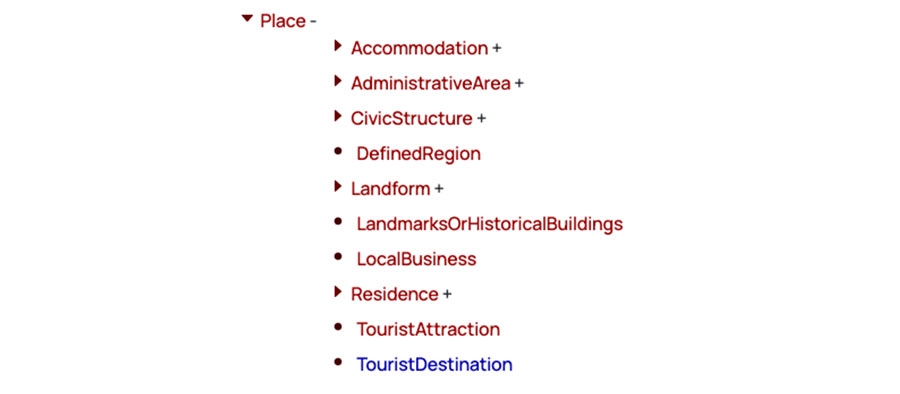
As we delve into the subcategories, the schema types become more specific:

The definitions within Schema.org allow us to pull from a finite (but broad) list of objects to help LLMs easily understand the purpose of the content on a website.
Where to Start (and Busting Some Myths)
One of the assumptions we encounter when embarking on schema implementation with our clients is that we need to add a plethora of new fields to every content type to see any results. The truth is, most of this relevant information already lives on your site. Schema helps tell the LLMs what they’re reading and how to interpret it. In most cases, the best way to prepare for implementing schema markup is the same way you prepare for strong SEO: publish high-quality content and make sure it’s clearly structured.
The easiest path forward is to:
- Take a look at your content and choose a schema “type” per content type or theme. For example, your ‘Event’ pages may be a good candidate for the Event Schema Type.
- Review the schema “properties” and see what can be mapped to existing fields. For example, your title will clearly match the ‘title’ field in Schema.org, etc.
- If you see something juicy on Schema.org, this is the time to determine if any of the listed properties might be helpful to add to your content type to provide more detailed information that would help LLMs and your users.
Example:
Let’s assume a website has an Event content type. This could be easily mapped to the Event Schema Type.
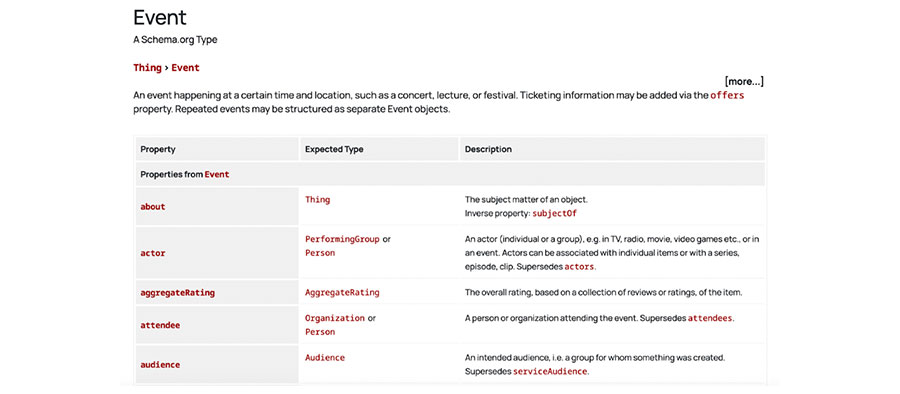
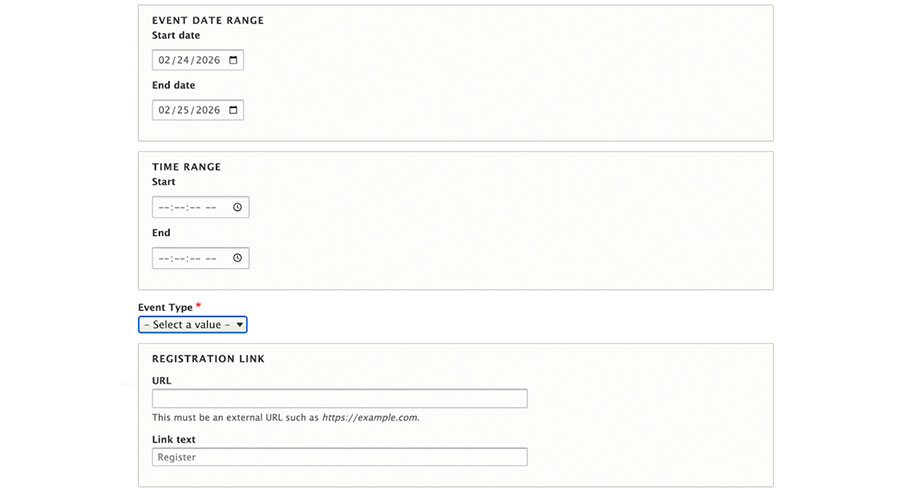
Our Event content type already has a number of fields with pertinent information about the event. Including things like:
- Date and time
- Location
- Room capacity
These can be easily mapped to properties of the Event type:
Example of an “Event” Drupal content type:
Example of the available fields on Schema.org:
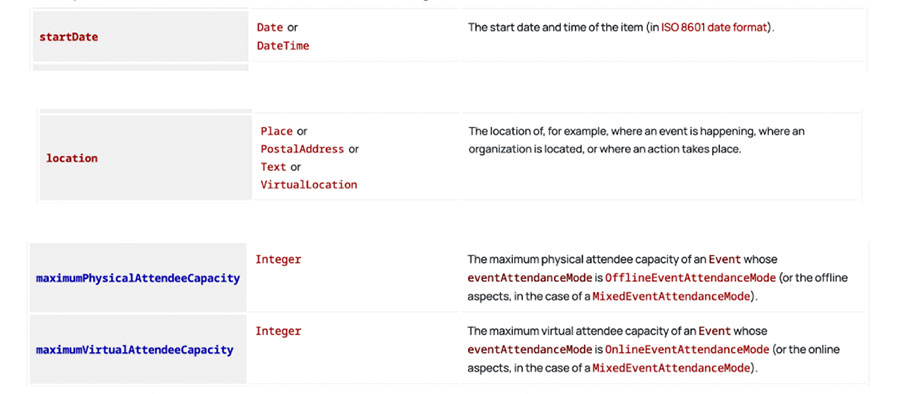
Our editors have been working hard to fill in this content on the website for SEO, so it already has a lot of the structured pieces. We're already starting with a healthy baseline to feed our event information into these properties of an Event.
We could also create a list of FAQs on an event page, especially for a larger event with location information or other logistics that might be helpful for users to know. However, that may not be relevant for every type of event. For an FAQ in Schema.org, it’s important that the content is in a structured question + answer set.
What Comes Next - Implement and Iterate
Just like with a traditional SEO model, schema markup and engagement measurement is not a one-and-done solution. We can let the data guide our choices when we follow these four steps:
- Implement
- Measure
- Refine
- Repeat
Measuring your baseline referral traffic before any schema markup is added to your site can give you an idea of what percentage you’re receiving from LLMs, and sets you up to be able to show measurable results after the schema is implemented. And we can use LLMs for contextual research as well. Ask Claude or ChatGPT or just Google about your organization’s events before and after you implement the schema, and see what gets surfaced.
Schema.org is all about making your existing content clearer for LLMs and users alike. By mapping what you already have to the right schema types and iterating based on results, you can boost discoverability, improve understanding, and create measurable impact—without overcomplicating your content.
If you’re interested in better optimizing your site and content for LLMs, reach out to us! We’re happy to help you along your AI optimization journey.