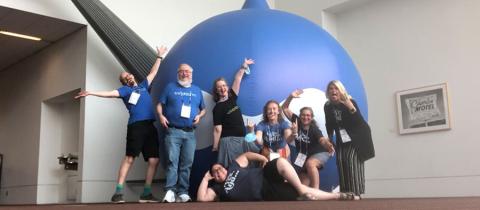
After over a year of Sandstorming, Will has been promoted to Writing, Research and Production—a title reflective of his many talents. As Sandstorm continues to grow, so do its employees. Will said the transition period has been one of his strongest growth spurts. He’s reached a personal and professional goal: do more great work, better.
Passionate about communication, Will explains that every facet of his new position—writing, research and production—encompasses it. “Writing is obvious. Usability testing and user research involves listening to people,” Will says, and his production role results in creating pieces that communicate a client’s brand to their audience.
Being the culture vulture that he is, Will spends his spare time writing sketch comedy and going to the opera. “Whether it’s through the written word, on stage or through music, conveying our thoughts, ideas and feelings are at the core of the human experience.” With an extensive music background to boot, Will is Sandstorm’s triple threat.
This September, I was on sabbatical volunteering in Peru. I had been accepted to a program through the Karikuy organization working to promote Peruvian tourism to English-speaking countries. Specifically, I was selected to do field research and travel writing to help develop the Peruvian Wikipedia, contribute to the Karikuy blog, and add content to the various Karikuy media galleries. So I spent the my time there exploring the country, learning everything I possibly could about Peru and Peruvian culture, capturing my journey on film, and sharing my experiences through articles, blogs, and video-longs along the way.
You can check out some of my work here:
http://www.karikuy.org/blog/
What attracted me most to the organization is that they truly want people to experience what life is like in Peru; and see, smell, touch, taste and hear everything that Peru has to offer. This is really rare in the tourism world, as most companies and organizations put their focus on Machu Picchu and the famous Inca Trail. And since Julio, the Program Director, is a native, he shares with the volunteers all of the hidden gems and lesser-known aspects of the Peruvian landscape, culture and life. (For instance, I learned that Peruvians are incredibly superstitious. The will not eat fish after 3pm (convinced it is no longer fresh), and believe that a red sunset means that there is going to be an earthquake.)
One of the greatest parts of the program was the people I was able to meet and share my travels with. There was not a single person I met that I didn’t like or have loads in common with. This was especially true with Elle, my roommate, who ironically enough also works for a boutique marketing and interactive firm specializing in user-centered design…all the way in Australia! :)
Overall, the experience was extremely rewarding and educational. I was able to familiarize myself with a country and a people in a way I never would have been able to on a typical vacation…and my life is forever changed for the better as a result.
Congrats Holly on being selected by Peru (yes, the country) to promote tourism to underdeveloped communities within the country! We are so proud of the work you are doing and can’t wait to read the daily blogs from your adventures. Yes, we will miss you this month as you go on sabbatical, but am honored to call you our coworker and friend.
How much effort goes into a brand name? Sometimes millions of dollars and hours of user research and analysis. Sometimes it’s a random employee who comes up with the idea through a contest (think Accenture – accent on the future). We do a lot of naming for our clients whether it be for a new initiative, a new product, a renaming of a company, an internal program, and there really is no one way to go about it. From a brainstorm to all the legal intellectual property searches, I wonder how many hours really went into some of the most well known names out there?
Many people ask me where Sandstorm came from. I should come up with a highly conceptual meaning, but that’s not how it happened. Sandstorm was a nickname of mine from college so I went with it because it was fun yet strong, spontaneous and energetic. Plus my maiden name was very difficult to pronounce, spell and remember. When I started the company in 1998 I had no idea that someday I would have an incredible agency filled with Sandstormers. Still wows me today.
Part of our user-centered web design process includes the development of personas through research and analysis. Persona’s have a noticeable advantage over traditional demographics because we (you, me, clients, etc) can relate to a person far more naturally than a list of stats and demographics. It’s human nature to bucket information into a way that you can remember, that you can relate to, that you can engage with – and a persona literally puts a name with a face on a fictional character that we can all discuss and create an amazing experience around.
So my big question is how far to go with the persona? How much detail is necessary to tell the story and paint the picture?
I would like to personally offer a free user research opportunity here for web site hosting companies – for those web site hosting companies that question what their customers want, need and feel. For those web site hosting companies that are serious about growing their hosting businesses by listening to their customers.
At the end of the day, what we value most, is the most simple of requests – that you please please please keep our web sites up and running. What we fear the most, is that you are going to take our web sites down for any number of reasons (fixing a bug, fixing a hack, server down for no particular reason, cold fusion crash, windows crash) and not let us know, and not have an answer to when it will be fixed, and quite frankly, move on with your day as if this is and should be expected. Many web site hosting companies brag about their up time, but here’s the catch. It’s not the uptime of our web sites, it’s the uptime of your servers, which doesn’t protect our web sites enough. This makes us (your users) not trust your hosting company.
Think of a user experience team (like us at Sandstorm) as a group advocating for web site surfers… basically your web site users whoever they may be. It’s easy to get caught up in business requirements while trying to build a web site/ interactive application/ online experience, but the goal of user centered design is to actually have your users drive some of your requirements.
We’ve been in more meetings that we can count where we’ll spend an hour or two discussing what we “think” the user wants, what we “think” the user needs for education and content, what we “think” the user will do when we build our site – and we “think” how much easier it would be if we just picked up the phone and asked a few. So we do, and more often than ever before, user research is driving more and more of our web design decisions – ultimately enhancing a user’s experience.